
Court finds BC’s involuntary treatment approach violates the Charter, but what does that mean?
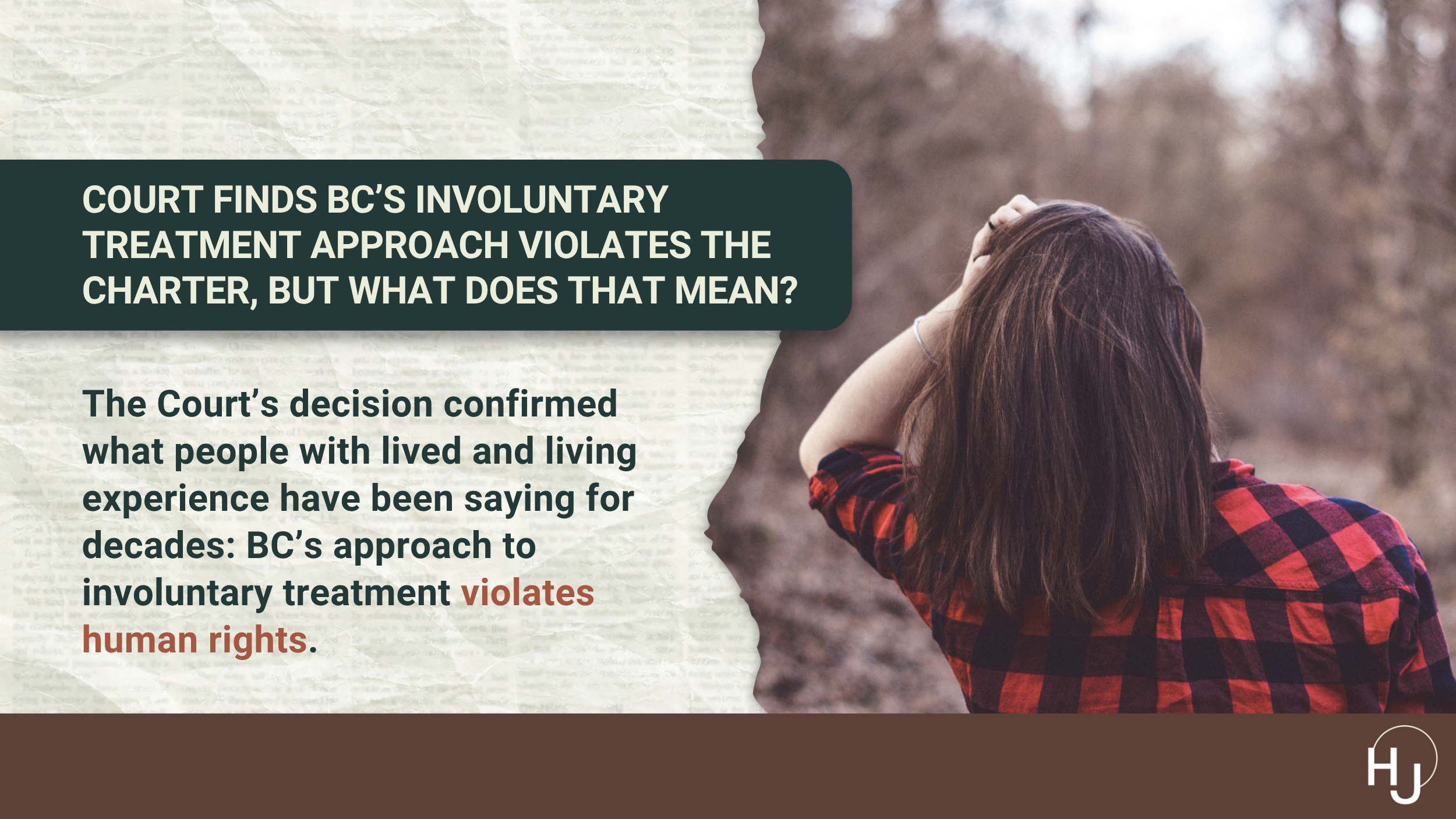
Text in graphic blocks along the left that reads “Court finds BC’s involuntary treatment approach violates the Charter, but what does that mean? The Court’s decision confirmed what people with lived and living experience have been saying for decades: BC’s approach to involuntary treatment violates human rights.” To the right of the text is an image of a person with long hair, wearing a plaid shirt running their hand through their hair. They are facing away and in the distance is some trees.
On July 30, the BC Supreme Court publicly released a decision finding that BC’s Mental Health Act violated the Charter of Rights and Freedoms.
The case was filed by the Council of Canadians with Disabilities (CCD) in 2016, represented by the Community Legal Assistance Society. They argued that specific sections of the Mental Health Act, the Health Care (Consent) and Care Facility (Admission) Act, and the Representation Agreement Act (Deemed Consent Laws) violate section 7 and section 15 of the Charter because they override health care consent rights for involuntary patients when it comes to psychiatric treatment decisions. You can read more about the case here.
Health Justice intervened in the case, and you can read our submissions here. We’re incredibly grateful to Devin Eeg and Nicole Gilewicz at Hunter Litigation Chambers for their pro bono representation for the intervention.
Looking for a short video summary? You can find that here.
What did the Court decide?
The Court’s decision confirmed what people with lived and living experience have been saying for decades: BC’s approach to involuntary treatment violates human rights. The decision is almost 400 pages long, so we’ve created a summary of what the Judge found.
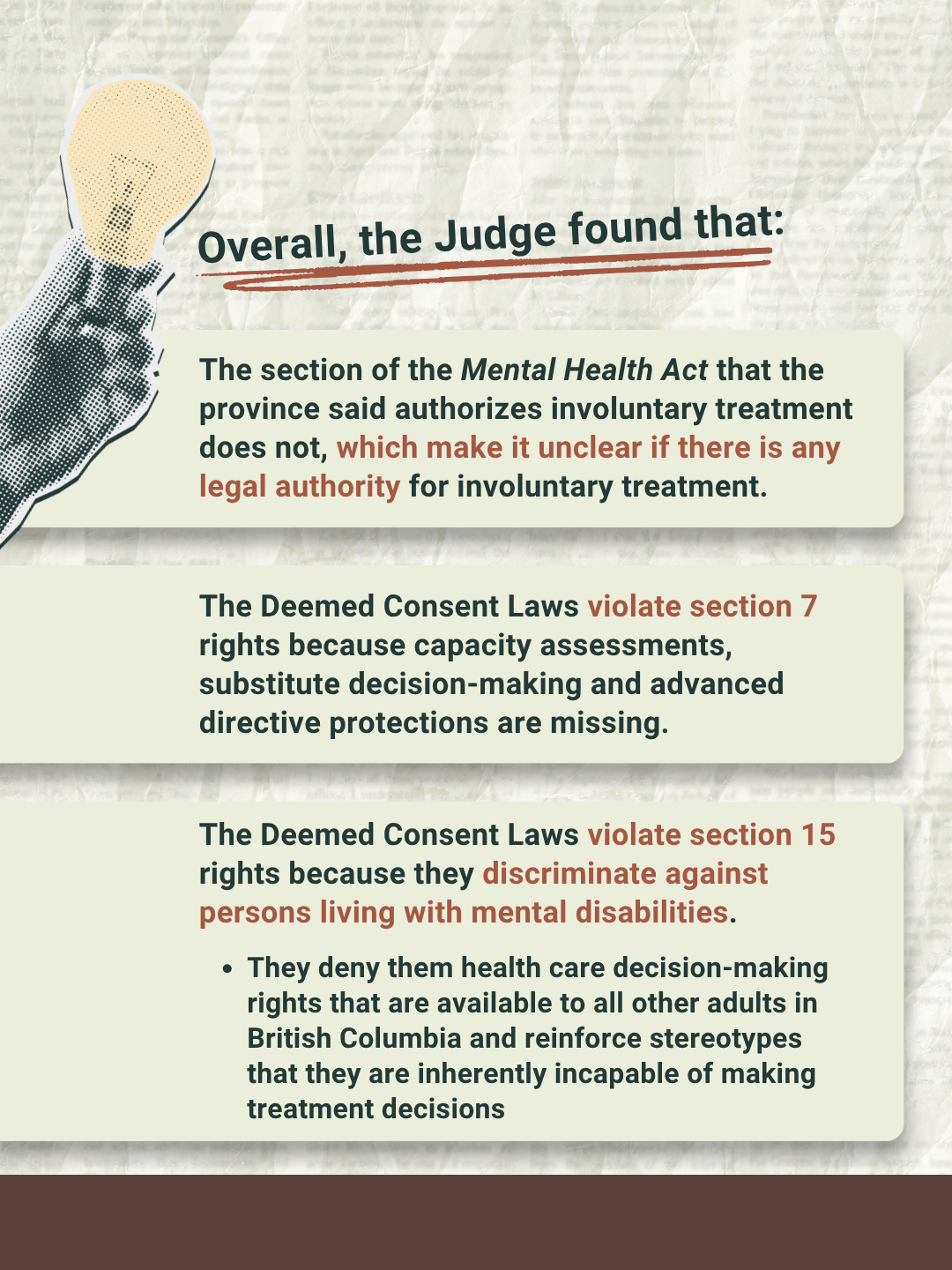
Overall, the Judge found that:
The section of the Mental Health Act that the province said authorizes involuntary treatment does not, which make it unclear if there is any legal authority for involuntary treatment.
The Deemed Consent Laws violate section 7 rights because capacity assessments, substitute decision-making and advanced directive protections are missing
The Deemed Consent Laws violate section 15 rights because they discriminate against persons living with mental disabilities.
They deny them health care decision-making rights that are available to all other adults in British Columbia and reinforce stereotypes that they are inherently incapable of making treatment decisions
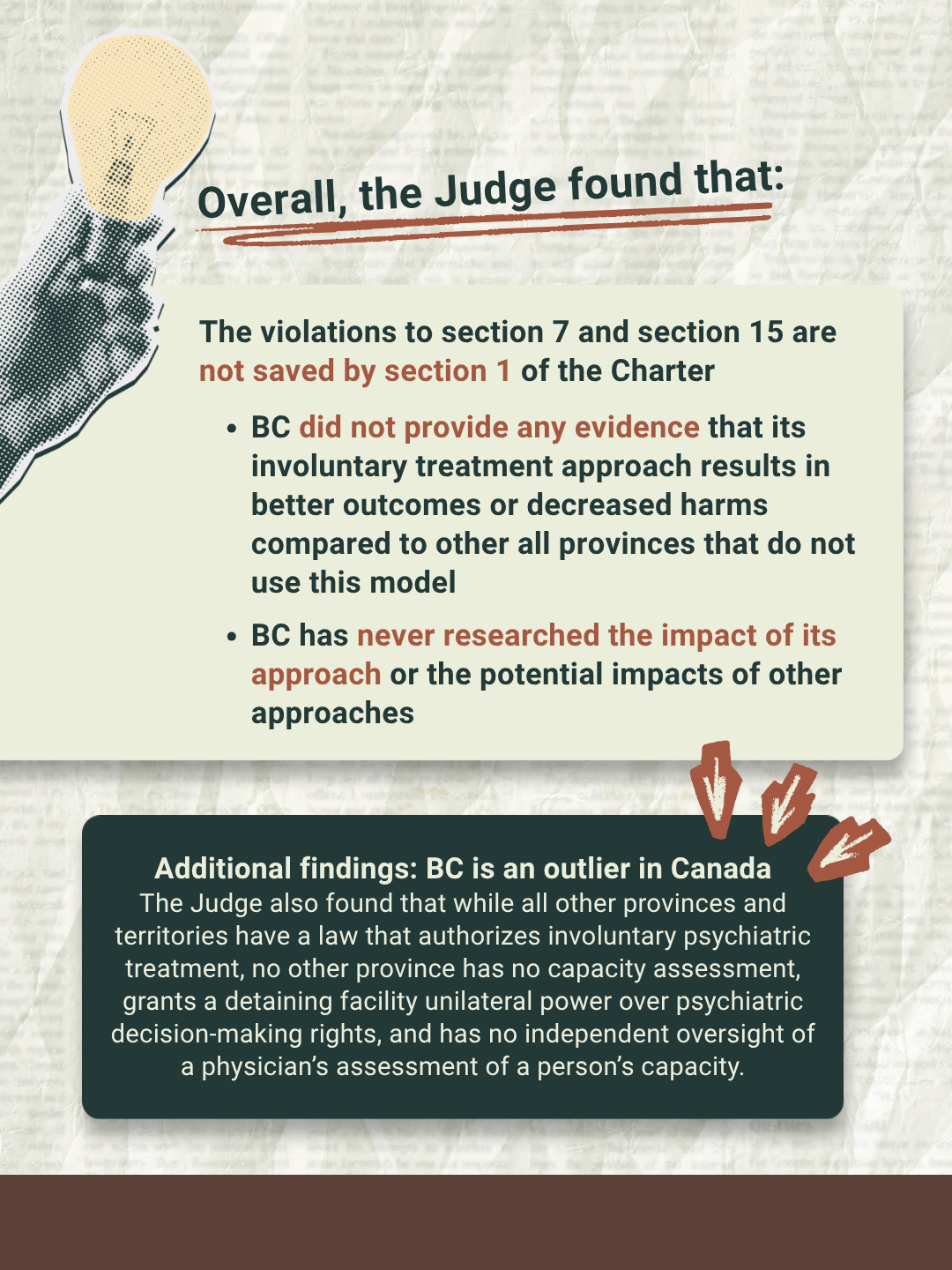
The violations to section 7 and section 15 are not saved by section 1 of the Charter
BC did not provide any evidence that its involuntary treatment approach results in better outcomes or decreased harms compared to other all provinces that do not use this model
BC has never researched the impact of its approach or the potential impacts of other approaches
Here’s a more detailed breakdown of the Judge’s findings:
-
When BC amended the Mental Health Act to remove the section referred to as “deemed consent,” it said the Act still authorizes involuntary treatment under a different section of the law, section 8(a). The Judge found this was not the case and section 8(a) does not authorize involuntary psychiatric treatment. This means that it’s not clear what, if any, legal authority currently exists for health care workers to administer involuntary treatment.
“The Impugned Provisions and the second half of s. 8(a) of the MHA work to completely eviscerate health care consent rights for involuntarily admitted patients, unless they consent to the proposed treatment. These impacts are grossly disproportionate to the legislation’s purpose.” (Decision at paragraph 866)
-
The Judge found that the way the Deemed Consent Laws override a person’s right to consent or refuse psychiatric treatment violates Charter rights to life, liberty and security of the person because they sometimes may heighten the risk of a patient’s death, deprive involuntary patients of their liberty to make medical decisions, and undermine their rights to bodily integrity and personal autonomy. The Judge found this was not in accordance with principles of fundamental justice because the law was arbitrary, overly board, and disproportionate to the purpose the involuntary treatment regime was meant to serve. More specifically, the Court found the laws violate section 7 rights because:
The Mental Health Act does not include any statutory requirement to assess a person’s capacity or find a person incapable of making a psychiatric treatment decision before forcing treatment. This means that someone can be capable of making their own psychiatric treatment decisions, meaning they understand the reason they need treatment, the risks and benefits of the treatment, and treatment alternatives, but still are not permitted to refuse it.
The Deemed Consent Laws do not allow for representation agreements or substitute decision-makers if a person is not capable of making their own psychiatric treatment decisions. This means people cannot choose who will make decisions if they are unable to, and there is no requirement to respect their wishes and values in psychiatric treatment decisions.
The Deemed Consent Laws do not respect advanced psychiatric treatment directives a person makes about their treatment wishes when they are capable. This means that people cannot plan for what they want to happen if they are ever incapable of making psychiatric treatment decisions.
-
“[I]n denying all involuntarily admitted patients the health care consent and decision-making rights everyone else enjoys, in favour of the ability of the director to authorize treatment, the impugned legislation furthers stereotypes about people living with mental disorders — that they lack the capacity to make these treatment decisions and are not entitled to the same right of self-determination all others are entitled to.” (Decision at paragraph 971)
The Court found that the Deemed Consent Laws also discriminate against persons living with mental disabilities because they deny them health care decision-making rights that are available to all other adults in British Columbia. The Judge found this denial reinforces stereotypes that people with mental disabilities are inherently incapable of making treatment decisions and are not entitled to the same right to self-determination and autonomy over their body as others because it forces a blanket approach that does not recognize a person’s individual differences or abilities.
-
The Court found the section 7 and 15 Charter violations are not saved by section 1 of the Charter. The Judge found that BC did not provide any evidence that its approach results in better outcomes or decreased harms compared to other all provinces that do not use this model, and that BC has never researched the impact of its approach or the potential impacts of other approaches despite knowing for decades that the Mental Health Act potentially violated the Charter.
Additional findings: BC is an outlier in Canada
The Judge also found that while all other provinces and territories have a law that authorizes involuntary psychiatric treatment, no other province has no capacity assessment, grants a detaining facility unilateral power over psychiatric decision-making rights, and has no independent oversight of a physician’s assessment of a person’s capacity.
What does the Court’s decision not say?
“It is important to stress that this is not a constitutional challenge to BC’s involuntary admission and detention regime at large. While the [Attorney General of BC] argues that CCD’s challenge to BC’s MHA Involuntary Treatment Regime entails profound consequences for the whole of the involuntary admission and detention regime set out in the MHA, CCD’s challenge is not to the entirety of the regime. Rather, their challenge is limited to whether BC’s manner of authorizing psychiatric treatment on behalf of a patient who is involuntarily detained is constitutional.” Decision at paragraph 25
The Council of Canadians with Disabilities did not argue and the Court did not find that all involuntary psychiatric treatment violates the Charter and it did not change the legal criteria for a person to be detained under the Mental Health Act. The decision only finds that the specific way the Mental Health Act and related laws override health care consent rights violates the Charter.
What evidence did the Court consider?
The Court heard 34 days of trial and considered evidence from 40 witnesses. This included:
14 witnesses with lived or living experience of involuntary treatment under BC’s Mental Health Act
9 family members of people with lived or living experience of involuntary treatment under BC’s Mental Health Act
14 experts, with areas of expertise including:
psychiatry
risk assessments
the history and development of mental health legislation and policy in Canada
mental health care policy
the risks and benefits of involuntary treatment
health related bio-ethics
stigma
substance use disorders and treatment
What does the Court’s decision mean in practice?
The Court gave BC six months to amend the law to remedy the Charter violations outlined in the decision. After six months, the Deemed Consent Laws will no longer have any force or authority. While the Court also suspended its declaration that section 8(a) of the Mental Health Act does not authorize involuntary treatment, that finding is an interpretation of the current law as BC amended it in December 2025. This part of the Court’s decision may create urgency for BC to amend the law ensure there is clarity about whether there is legal authority for involuntary treatment.
It is now up to BC to choose how they want to proceed in response to the Court’s decision. They can choose to appeal it, or they can engage with stakeholders including people with lived and living experience and human rights experts to address the serious human rights violations confirmed by the Court.
Did you find this interesting? Share this post!